Moving Beyond Prompts: A Shift in How AI Systems Are Built
<style>
.blog-details-area.pt-5.pb-5{background-color: #f4f8fd;}
.article-image{display:none}
.hero {
background: linear-gradient(135deg, #0f172a 0%, #1e293b 100%);
color: white;
padding: 100px 0 120px;
clip-path: polygon(0 0, 100% 0, 100% 90%, 0% 100%);
}
.list-unstyled{padding-left: 25px !important;}
.list-unstyled:before{ content: "\e9f4" !important;
font-family: boxicons !important;
font-size: 16px;
top: 0 !important;
width: 0 !important;
height: 0 !important;
color: #ff1628;}
.icon-box:before{content: "\e9f6" !important;
font-family: boxicons !important;
font-size: 30px;}
.card-custom {
border: none !important;
box-shadow: 0 10px 40px rgba(0,0,0,0.04);
transition: all 0.3s ease;
height: 100%;
}
.card-custom:hover {
transform: translateY(-10px);
box-shadow: 0 20px 50px rgba(0,0,0,0.08);
}
.icon-box {
width: 45px;
height: 45px;
background: rgba(56, 189, 248, 0.1);
color: #38bdf8;
border-radius: 15px;
display: flex;
align-items: center;
justify-content: center;
font-size: 1.5rem;
margin-bottom: 20px;
}
.badge-ai {
background: rgba(56, 189, 248, 0.2);
color: #38bdf8;
font-weight: 700;
padding: 8px 16px;
border-radius: 50px;
text-transform: uppercase;
font-size: 0.75rem;
letter-spacing: 1px;
}
.table-custom th { background: #0f172a; color: white; border: none; padding: 15px; }
.table-custom td { padding: 15px; vertical-align: middle; border-bottom: 1px solid #f1f5f9; }
.footer-banner {
background: #0f172a;
color: white;
padding: 60px 0;
margin-top: 80px;
}
.btn-modern {
padding: 12px 35px;
border-radius: 12px;
font-weight: 600;
transition: 0.3s;
}
.highlight {
background: #eef4ff;
border-left: 4px solid #00196c;
border-right: 4px solid #00196c;
padding: 25px;
border-radius: 10px;
height: 100%;
}
.br-3{
border-radius: 10px;
}
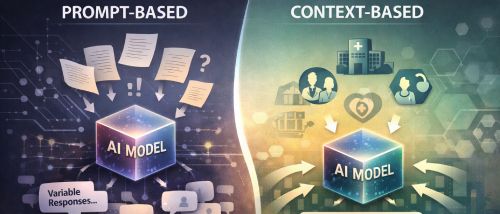
</style><section class="mt-n5" style="margin-top:-50px;"><div class="row g-4"><div class="col-12"><div class="card card-custom p-5 bg-white border"><div class="row align-items-center"><div class="col-lg-6"><p>There was a time when improving AI systems felt straightforward. The solution seemed simple:</p><ul><li class="list-unstyled mb-2">Make instructions clearer</li><li class="list-unstyled mb-2">Add examples</li><li class="list-unstyled mb-2">Guide the model step by step</li></ul><p>With these adjustments, systems powered by models like GPT began producing strong outputs.</p></div><div class="col-lg-6"><img class="img-fluid rounded-4 shadow-lg" src="/uploads/moving_beyond_prompts_9366fdaa7a.jpg" alt="moving_beyond_prompts"></div><div class="col-12 mt-3"><p>However, this approach quickly showed its limits when applied to real-world scenarios. It became clear that the real challenge was not the prompt itself, but everything surrounding it.</p></div></div></div></div><div class="col-md-6"><div class="card card-custom p-4"><div class="icon-box"> </div><h4 class="fw-bold">A Practical Scenario</h4><p class="text-muted small">Consider an AI assistant designed for a healthcare provider. It must handle requests such as:</p><ul><li class="list-unstyled">Booking appointments</li><li class="list-unstyled">Rescheduling visits</li><li class="list-unstyled">Checking doctor availability</li><li class="list-unstyled">Answering basic medical service queries</li></ul><p>At first, this appears to be a straightforward language problem. <br>But once deployed, several issues emerged.</p></div></div><div class="col-md-6"><div class="card card-custom p-4"><div class="icon-box" style="background-color:rgba(244, 63, 94, 0.1);color:#f43f5e;"> </div><h4 class="fw-bold">Initial Approach: Prompt-Focused Design</h4><p class="text-muted small">Early implementations relied entirely on passing well-structured text to the model. For example:</p><ul><li class="list-unstyled">Define the assistant's role</li><li class="list-unstyled">Include the user's query</li><li class="list-unstyled">Attach relevant details such as available time slots</li></ul><p>This works well in controlled environments and simple demonstrations.</p></div></div></div></section><section class="pt-5 pb-5"><h4 class="section-title text-center mb-0">WHERE PROBLEMS BEGIN</h4><p class="text-center">As usage grows, limitations become visible.</p><div class="row g-4"><div class="col-md-4"><div class="card card-custom p-4 br-3 text-center"><h6>Lack of Continuity</h6><p>The system cannot reliably carry patient details across interactions, forcing users to repeat information.</p></div></div><div class="col-md-4"><div class="card card-custom p-4 br-3 text-center"><h6>Unpredictable Responses</h6><p>Identical queries may produce slightly different answers, which is problematic in sensitive domains.</p></div></div><div class="col-md-4"><div class="card card-custom p-4 br-3 text-center"><h6>Incorrect Assumptions</h6><p>Without verified data, the model may suggest unavailable time slots or incorrect information.</p></div></div><div class="col-md-4"><div class="card card-custom p-4 br-3 text-center"><h6>Sensitivity to changes</h6><p>Small variations in wording can lead to inconsistent outcomes.</p></div></div><div class="col-md-4"><div class="card card-custom p-4 br-3 text-center"><h6>Inefficient context handling</h6><p>Passing full conversation history increases cost and introduces noise.</p></div></div></div></section><section><div class="row"><div class="col-md-6"><div class="highlight mb-3"><h5>The Underlying Issue</h5><p>The core flaw lies in treating AI interactions as isolated events. Production systems require:</p><div class="row mt-3"><div class="col-md-4">✔ Memory of past interactions</div><div class="col-md-4">✔ Access to real-time system data</div><div class="col-md-4">✔ Structured handling of context</div></div></div></div><div class="col-md-6"><div class="highlight mb-3"><h5>A Different Approach: Context-Oriented Design</h5><p>Instead of focusing on how instructions are written, modern systems focus on what information is provided to the model.</p><p>This marks a shift from prompt design to context design.</p></div></div></div></section><section class="pt-5 pb-5"><h4 class="section-title text-center mb-0">REFRAMING THE SAME SYSTEM</h4><p class="text-center">Rebuilding the earlier example with this approach introduces several changes.</p><div class="row g-4"><div class="col-md-4"><div class="card card-custom p-4 br-3 text-center"><h6>Organized Inputs</h6><p>Information is passed in a structured format rather than free text. This reduces ambiguity and improves reliability.</p></div></div><div class="col-md-4"><div class="card card-custom p-4 br-3 text-center"><h6>Selective Context</h6><p>Only relevant information is included before generating a response. This improves efficiency and reduces noise.</p></div></div><div class="col-md-4"><div class="card card-custom p-4 br-3 text-center"><h6>Standardized Outputs</h6><p>Responses are structured rather than fully freeform. This makes it easier for them to test, validate, and integrate.</p></div></div><div class="col-md-6"><div class="card card-custom p-4 br-3"><h6>Explicit Memory</h6><p>Different layers of memory are maintained:</p><ul><li class="list-unstyled">recent interaction history</li><li class="list-unstyled">session-specific data (e.g., selected doctor, preferred time)</li><li class="list-unstyled">long-term user information (e.g., patient profile)</li></ul><p>This enables continuity and personalization.</p></div></div><div class="col-md-6"><div class="card card-custom p-4 br-3"><h6>Data Retrieval</h6><p>Instead of relying on internal knowledge, the system fetches real data:</p><ul><li class="list-unstyled">doctor schedules</li><li class="list-unstyled">appointment availability</li><li class="list-unstyled">clinic rules</li></ul><p>This ensures accuracy and reduces guesswork.</p></div></div></div></section><section><div class="row"><div class="col-12 text-center"><h4>Comparing the Two Approaches</h4></div><div class="col-md-6"><div class="highlight mb-3"><h5>Prompt-based Systems</h5><ul><li class="list-unstyled">Rely on raw text</li><li class="list-unstyled">Lack reliable memory</li><li class="list-unstyled">Depend on fixed instructions</li><li class="list-unstyled">Produce variable outputs</li></ul></div></div><div class="col-md-6"><div class="highlight mb-3"><h5>Context-based Systems</h5><ul><li class="list-unstyled">Use structured inputs</li><li class="list-unstyled">Maintain multiple memory layers</li><li class="list-unstyled">Dynamically assemble context</li><li class="list-unstyled">Rely on real data sources</li><li class="list-unstyled">Generate controlled outputs</li></ul></div></div></div></section><section class="pt-5 pb-5"><h4 class="section-title text-center">Impact of the Shift</h4><div class="row g-4"><div class="col-md-3"><div class="card card-custom p-4 br-3"><h6>Improved accuracy</h6><p>because responses are grounded in actual data</p></div></div><div class="col-md-3"><div class="card card-custom p-4 br-3"><h6>Better user experience</h6><p>because interactions feel consistent and continuous</p></div></div><div class="col-md-3"><div class="card card-custom p-4 br-3"><h6>Lower operational cost</h6><p>because only necessary information is processed</p></div></div><div class="col-md-3"><div class="card card-custom p-4 br-3"><h6>Easier maintenance</h6><p>because systems are designed as pipelines rather than prompt collections</p></div></div></div></section><h4>The Bigger Perspective</h4><p>The earlier mindset assumed that the model itself was the entire system. The newer approach treats the model as just one part within a larger architecture that includes:</p><div class="row"><div class="col-md-auto"><ul><li class="list-unstyled">Memory</li></ul></div><div class="col-md-auto"><ul><li class="list-unstyled">Retrieval</li></ul></div><div class="col-md-auto"><ul><li class="list-unstyled">Decision-making</li></ul></div><div class="col-md-auto"><ul><li class="list-unstyled">Execution</li></ul></div></div><h4 class="mt-3">Conclusion</h4><p>Refining prompts was an important starting point, but it is no longer sufficient. The gold right now is to:</p><div class="row"><div class="col-md-auto"><ul><li class="list-unstyled">Choosing the right data</li></ul></div><div class="col-md-auto"><ul><li class="list-unstyled">Structuring it effectively</li></ul></div><div class="col-md-auto"><ul><li class="list-unstyled">Providing it at the right moment</li></ul></div></div><p>In the end, system performance depends less on how instructions are written and more on how context is managed. <br>That difference is what separates simple demonstrations from reliable, production-ready solutions.</p>
If you are interested in exploring more on this topic please get in touch with us on insights@fintinc.com.